Hard Water in Florida: The Complete Homeowners Guide (2026)
If you've noticed white spots on your dishes, stubborn soap scum, dry skin after showering, or appliances wearing out sooner than they should, there's a good chance your home has hard water.
Hard water is one of the most common water quality issues throughout Central Florida. While it isn't considered dangerous to drink, it can quietly cost homeowners hundreds—or even thousands—of dollars over time through damaged plumbing, higher energy bills, excessive soap use, and premature appliance failure.
At 1st Choice Water Softeners, we perform free in-home water testing throughout Central Florida. One of the most common things we hear is:
"I had no idea my water was this hard."
This guide explains everything you need to know.
What Is Hard Water?
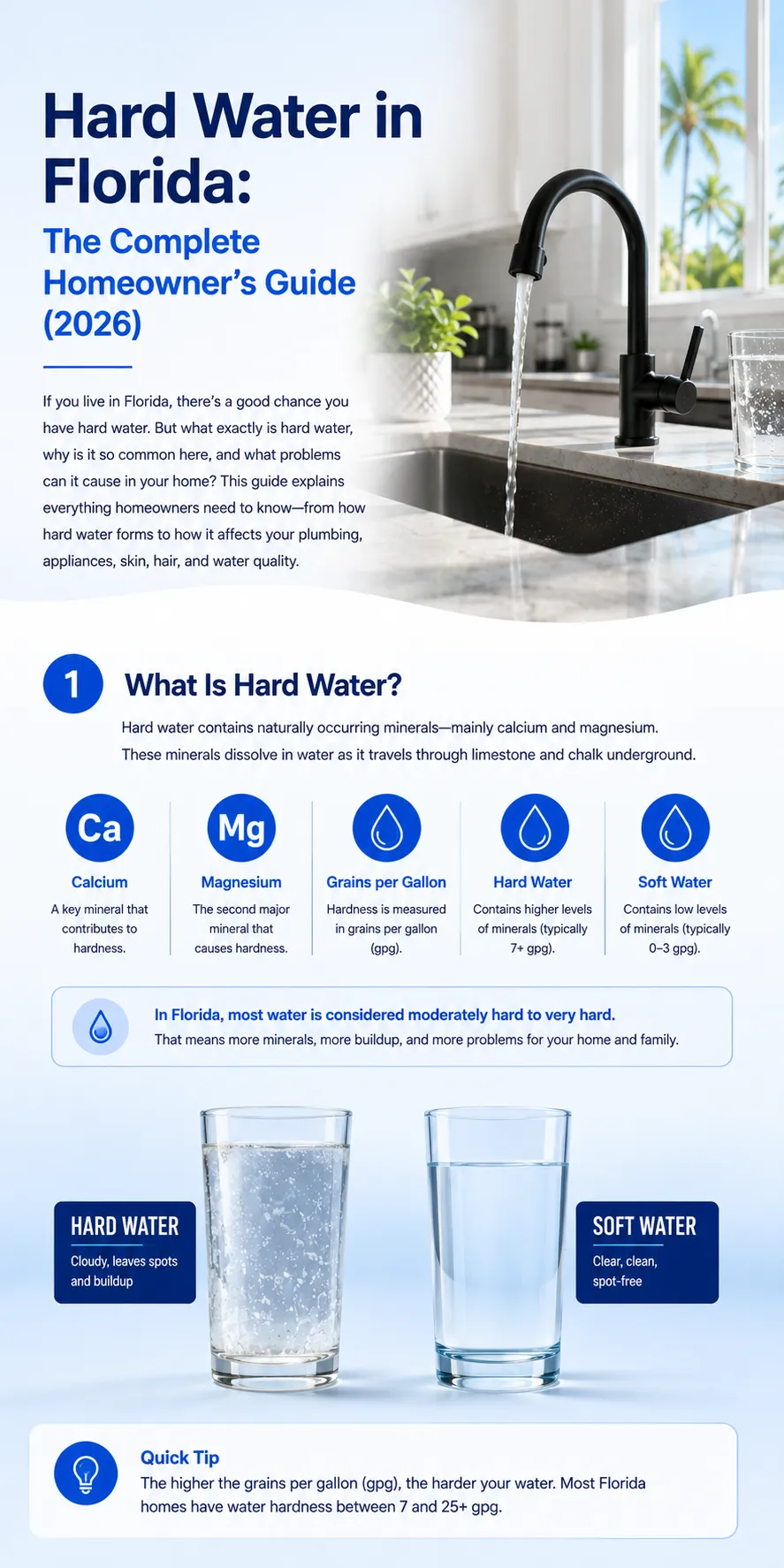
Hard water is water that contains elevated levels of naturally dissolved minerals, primarily calcium and magnesium. These minerals are not pollutants or chemicals added by water treatment plants. Instead, they are picked up naturally as water travels through the earth before reaching your home.
To understand hard water, it helps to understand where your water comes from.
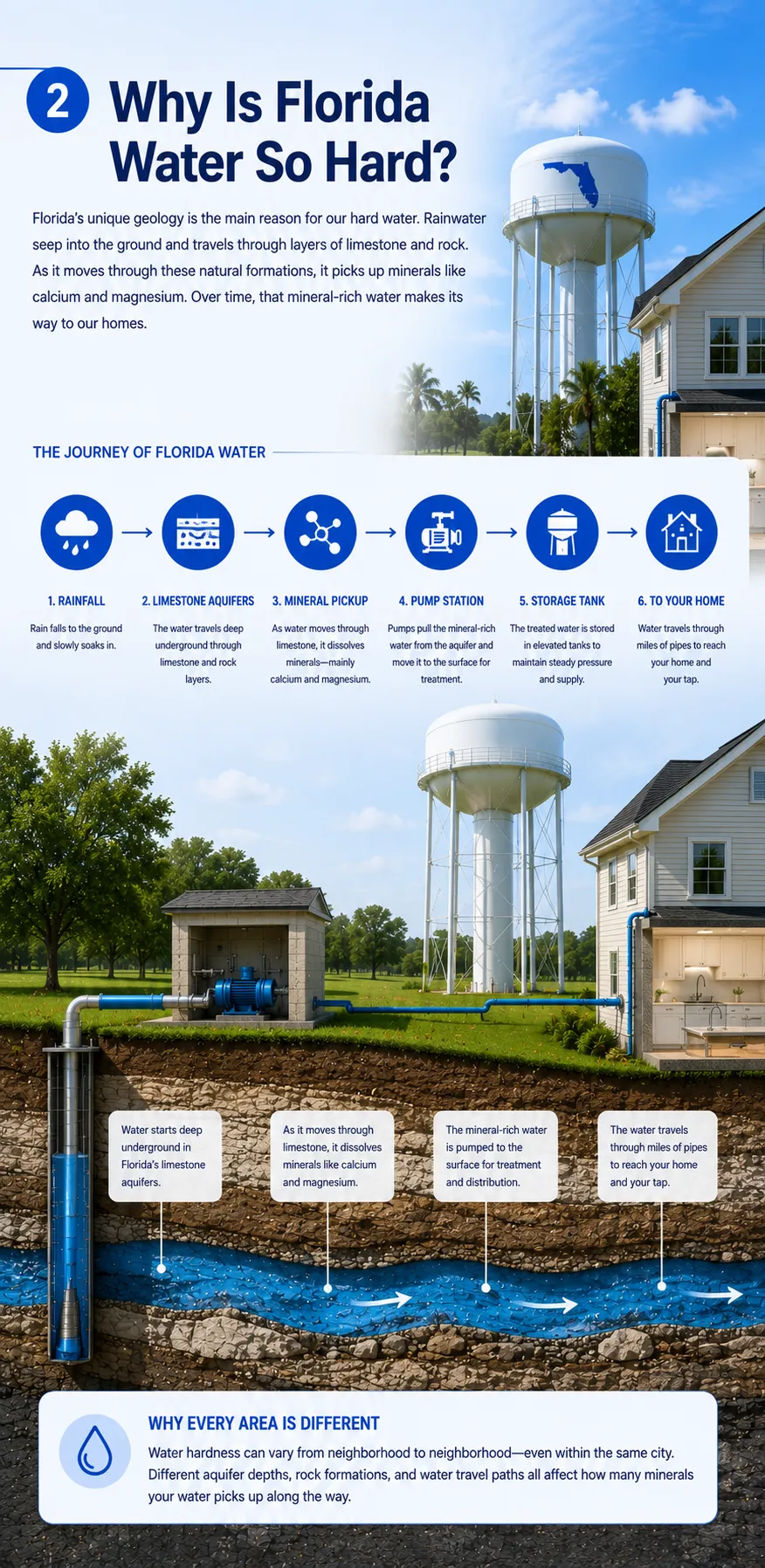
Every drop of rain that falls begins as relatively pure water. As that rainwater seeps into the ground, it slowly filters through layers of soil, sand, clay, and rock on its journey toward underground aquifers. During this process, water acts as what scientists often call the "universal solvent." Water molecules naturally dissolve small amounts of minerals from the rocks and soil they pass through.
The amount and type of minerals the water dissolves depends entirely on the geology beneath the surface.
In Florida, this process is especially significant because much of the state sits on the Floridan Aquifer, one of the largest and most productive aquifer systems in the world. The Floridan Aquifer is made up primarily of porous limestone and dolomite, both of which are rich in calcium and magnesium minerals.
As groundwater slowly moves through these limestone formations—sometimes over months, years, or even decades—it continually dissolves tiny amounts of these minerals. By the time the water reaches a residential well or municipal well field, it often contains enough dissolved calcium and magnesium to be classified as hard water.
This is why hard water is so common throughout Florida. It isn't caused by poor water quality or pollution. In fact, it is simply the result of water spending a long time in contact with mineral-rich rock underground.
The hardness of water can vary dramatically from one location to another, even within the same county. Two homes only a few miles apart may have very different hardness levels because they draw water from different depths, different wells, or different portions of the aquifer. One home may have moderately hard water, while another may have extremely hard water despite being on the same street.
Municipal water systems are not immune to hard water either. Most city water in Central Florida also originates from groundwater wells drilled into the Floridan Aquifer. While municipalities disinfect and treat the water to meet drinking water standards, they generally do not remove hardness minerals. Removing calcium and magnesium from millions of gallons of water every day would require large-scale softening facilities that are expensive to build and operate. As a result, many homeowners on city water experience the same hard water problems as homeowners on private wells.
It's also important to understand that calcium and magnesium remain completely dissolved in the water. You cannot usually see them floating in a glass, and hard water often looks just as clear as soft water. In many cases, the only way to know how hard your water is is through proper testing.
Another common misconception is that hard water is caused by sediment or dirt in the water. This is not the case. Sediment consists of solid particles that can often be filtered out with a sediment filter. Hardness minerals, however, are dissolved at the molecular level. Because they are dissolved into the water itself, they pass straight through ordinary sediment filters and most cartridge filters without being removed.
The concentration of calcium and magnesium is what determines how "hard" the water is. Water that has only a small amount of dissolved minerals is considered soft. As those mineral concentrations increase, the water becomes moderately hard, hard, or very hard.
The geology beneath your home has been creating hard water for thousands of years, and it will continue to do so naturally. That's why hard water isn't a temporary problem or something that changes with the seasons. It is simply a characteristic of the groundwater source itself.
Understanding where hard water comes from helps explain why it is so widespread throughout Florida and why treating it requires specialized equipment. Since the minerals are dissolved into the water rather than suspended in it, they cannot simply be strained out with a basic filter. Addressing hard water requires a treatment method specifically designed to remove dissolved hardness minerals before they circulate throughout your home's plumbing system.
How Hard Is Florida Water?
Many areas of Central Florida range between:
8 grains per gallon
15 grains per gallon
20+ grains per gallon
Some wells can exceed 30 grains per gallon.
For comparison:
0–1 GPG = Soft
1–3.5 GPG = Slightly Hard
3.5–7 GPG = Moderately Hard
7–10.5 GPG = Hard
Over 10.5 GPG = Very Hard
Many Florida homeowners are living with water that is considered very hard.
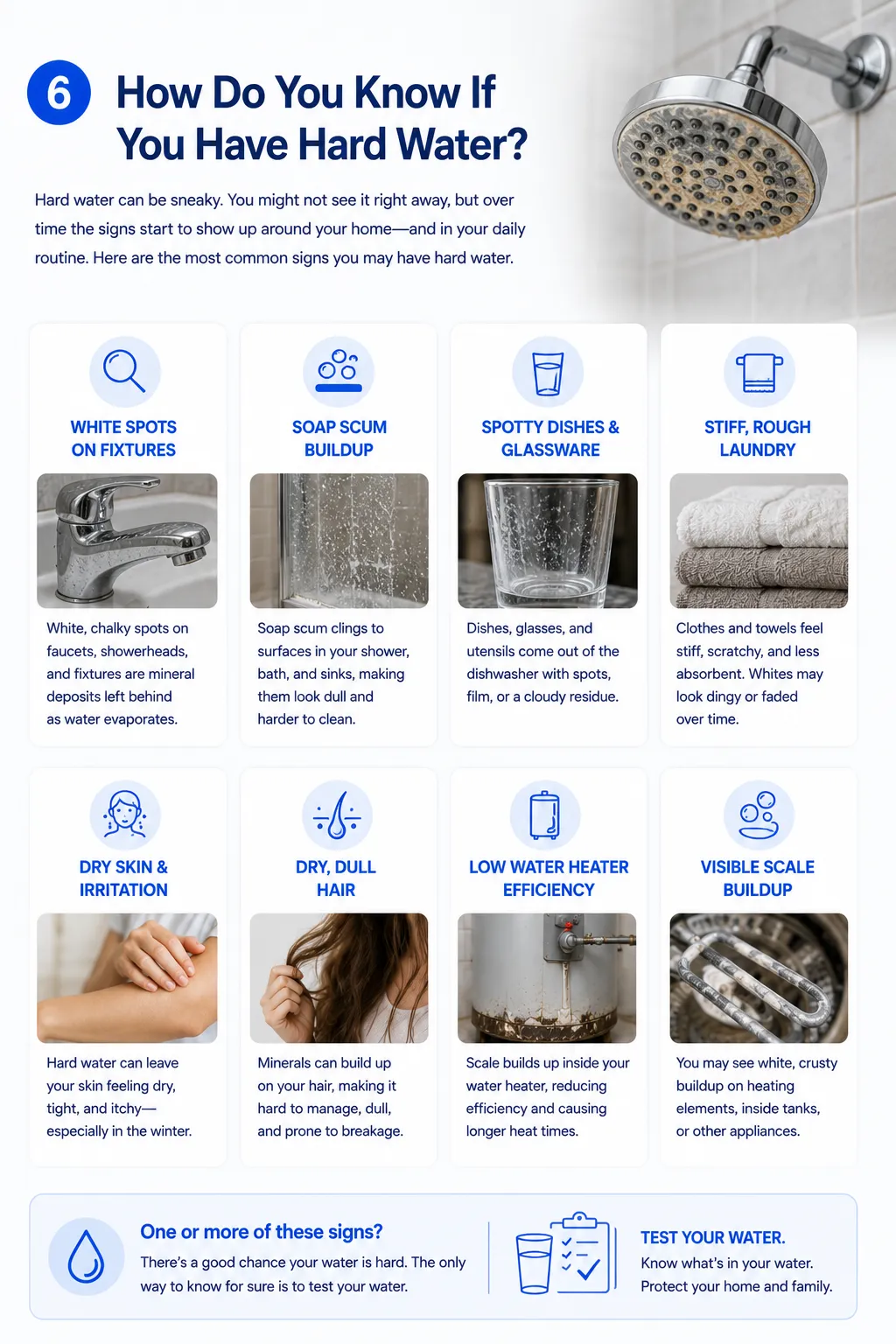
Signs You Have Hard Water
Hard water doesn't usually announce itself with one obvious problem. Instead, it creates a collection of small frustrations that gradually become part of everyday life. Because the minerals are dissolved in the water, it often looks perfectly clear, making it difficult to recognize hard water without proper testing.
Some of the most common signs include:
White spots on dishes and glassware
Soap that doesn't lather well
Soap scum on showers, tubs, and sinks
Dry, itchy skin after bathing
Hair that feels rough, dull, or difficult to manage
White mineral buildup around faucets and showerheads
Reduced water flow from clogged faucet aerators and showerheads
Water heaters that become less efficient over time
Clothes that feel stiff, faded, or less soft after washing
Frequent plumbing fixture or appliance maintenance
Many homeowners assume these issues are simply part of living in Florida, but they're often symptoms of hard water. If you've found yourself constantly cleaning white residue from fixtures, using more soap than you think you should, or replacing faucet cartridges and showerheads more often than expected, hard water could be the underlying cause.
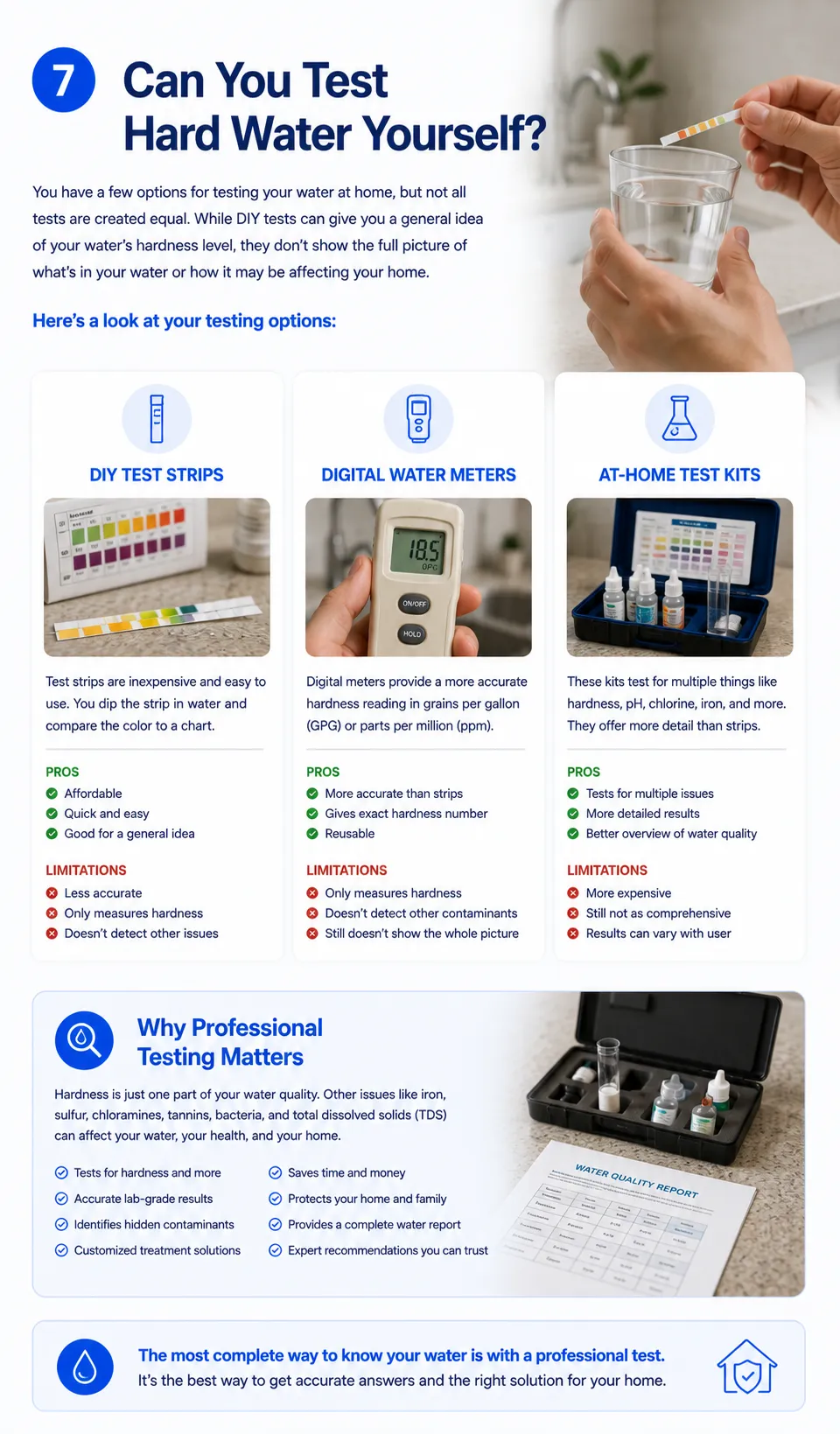
While these signs can strongly suggest hard water, the only way to know for certain is through a professional water analysis. Measuring your water's hardness allows you to determine not only if hard water is present, but also how severe the problem is and whether any additional water quality issues should be addressed.
Does Hard Water Damage Plumbing?
Yes!
Hard water doesn't usually damage your plumbing overnight. Instead, it works slowly over many years as dissolved calcium and magnesium are left behind every time water is heated, evaporates, or changes pressure.
As water travels through your plumbing system, those dissolved minerals remain invisible. However, once water is heated inside a water heater or evaporates from a faucet, showerhead, or fixture, the minerals are no longer able to stay dissolved. They begin to crystallize and attach themselves to nearby surfaces, forming what is known as limescale or mineral scale.
At first, these deposits may seem insignificant, but they continue growing every time water flows through your home. Over the years, a thin layer of scale can become a thick, rock-like coating that affects nearly every plumbing fixture and water-using appliance.
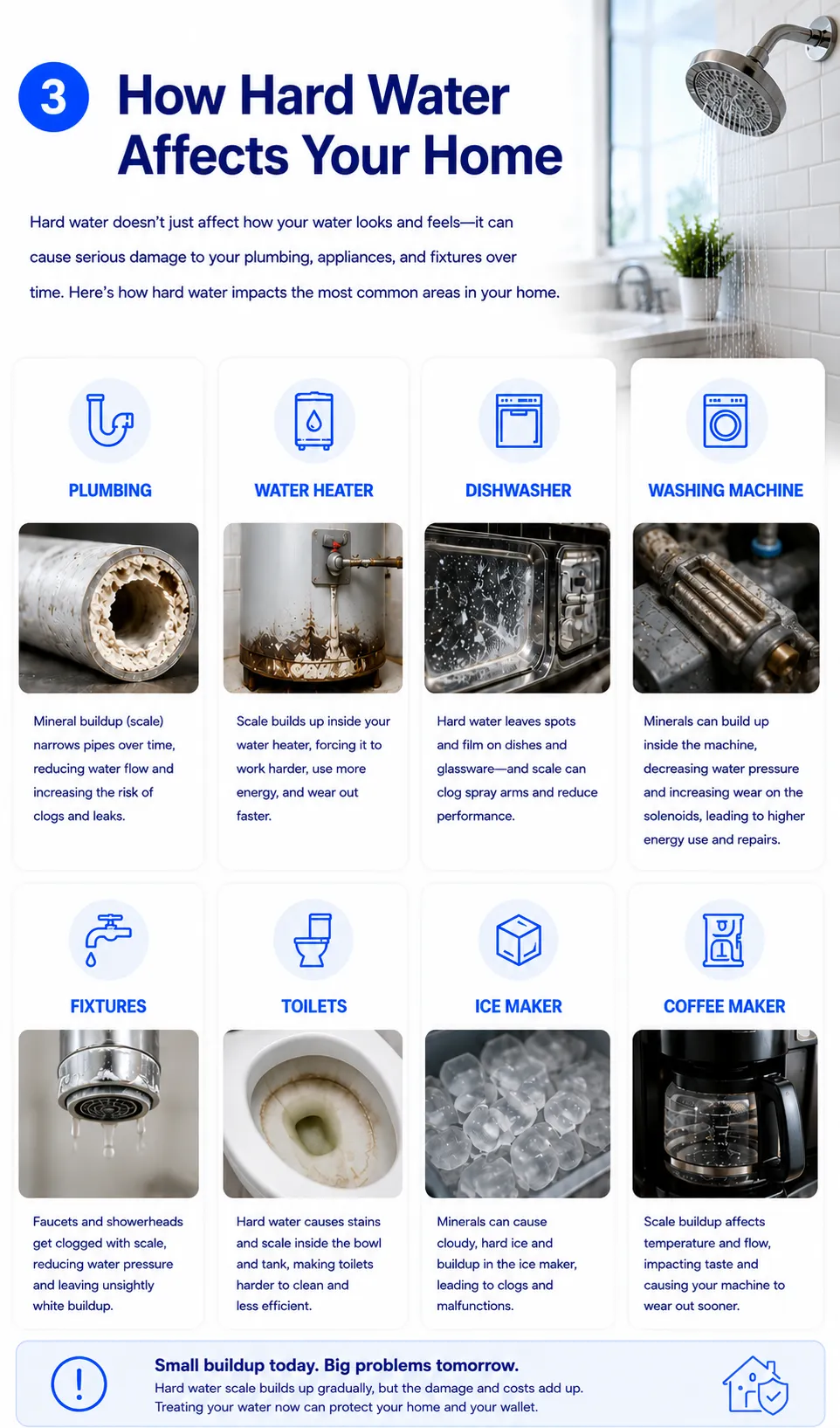
One of the first places homeowners notice hard water is on faucet aerators. The tiny openings inside the aerator gradually become plugged with mineral deposits, restricting water flow and causing uneven spray patterns. Showerheads experience the same problem as individual spray nozzles slowly clog with calcium buildup, reducing pressure and creating an inconsistent spray.
Inside your plumbing system, scale can accumulate on shut-off valves, angle stops, faucet cartridges, toilet fill valves, washing machine valves, and other moving components. Mineral deposits build up on sealing surfaces and moving parts, preventing them from operating as smoothly as they were designed to. As valves become harder to turn and cartridges become more difficult to move, the rubber seals and O-rings are forced to slide across rough mineral deposits instead of smooth machined surfaces. Over time, this additional abrasion can accelerate wear on seals, O-rings, valve seats, and faucet cartridges, increasing the likelihood of drips and leaks.
Hard water can also cause scale to build up where rubber seals meet brass components. Instead of sealing against a smooth surface, the rubber must seal against hardened mineral deposits. This can prevent a complete seal and contribute to leaks over time. In severe cases, repeated scale buildup and removal can leave sealing surfaces rougher than when they were new, making repairs more difficult.
Water heaters are particularly vulnerable because heating water dramatically reduces the ability of calcium to remain dissolved. As a result, hardness minerals settle out of the water and collect on the bottom of tank-style water heaters or coat the heat exchangers inside tankless units. Even a relatively thin layer of scale acts as an insulator, forcing the heating element or burner to work harder to transfer heat into the water. This reduces efficiency, increases energy consumption, and can shorten the life of the appliance.
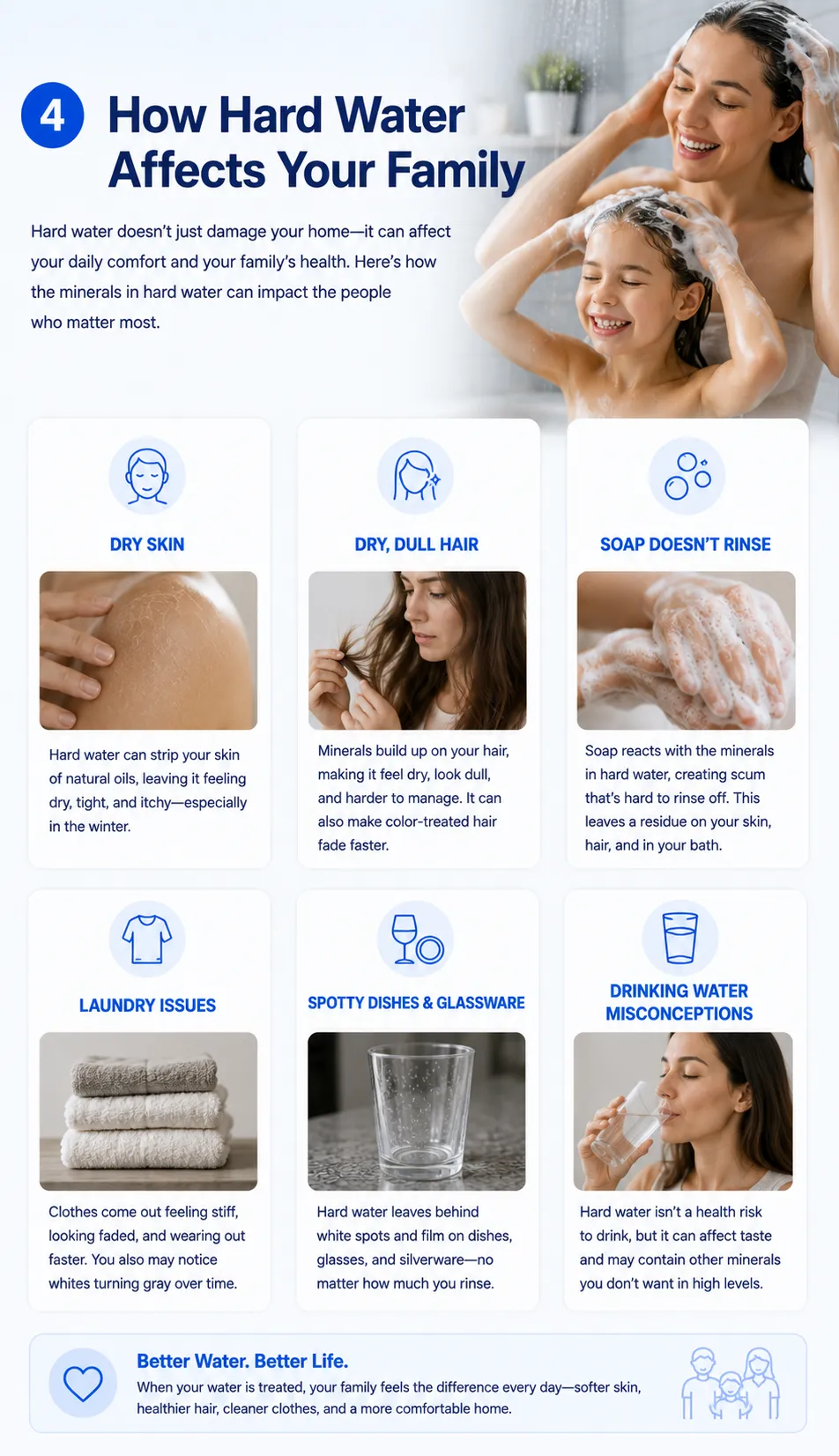
Hard water also affects your home's cleaning performance. Soap molecules naturally react with calcium and magnesium, creating an insoluble residue commonly known as soap scum. Instead of producing a rich lather, part of the soap is essentially used up reacting with hardness minerals before it ever has a chance to clean. This is why many homeowners find themselves using more shampoo, body wash, laundry detergent, dishwasher detergent, and household cleaners when living with hard water.
Over time, mineral deposits may also collect inside coffee makers, ice makers, humidifiers, dishwashers, washing machines, and other appliances that regularly heat or evaporate water. These deposits can reduce performance, increase maintenance requirements, and shorten the service life of expensive equipment.
Because hard water works gradually, many homeowners don't notice the damage until years have passed. Reduced water flow, stubborn faucet leaks, inefficient water heaters, shortened appliance life, and increased maintenance costs are often the cumulative result of mineral scale slowly building throughout the home's plumbing system.
This gradual process is why hard water is often described as a long-term plumbing issue rather than an immediate one. The water may appear perfectly clear every time it comes out of the tap, but with each gallon used, tiny amounts of dissolved minerals are left behind. Over the course of thousands of gallons, those tiny deposits become a significant source of wear, maintenance, and expense throughout the home.
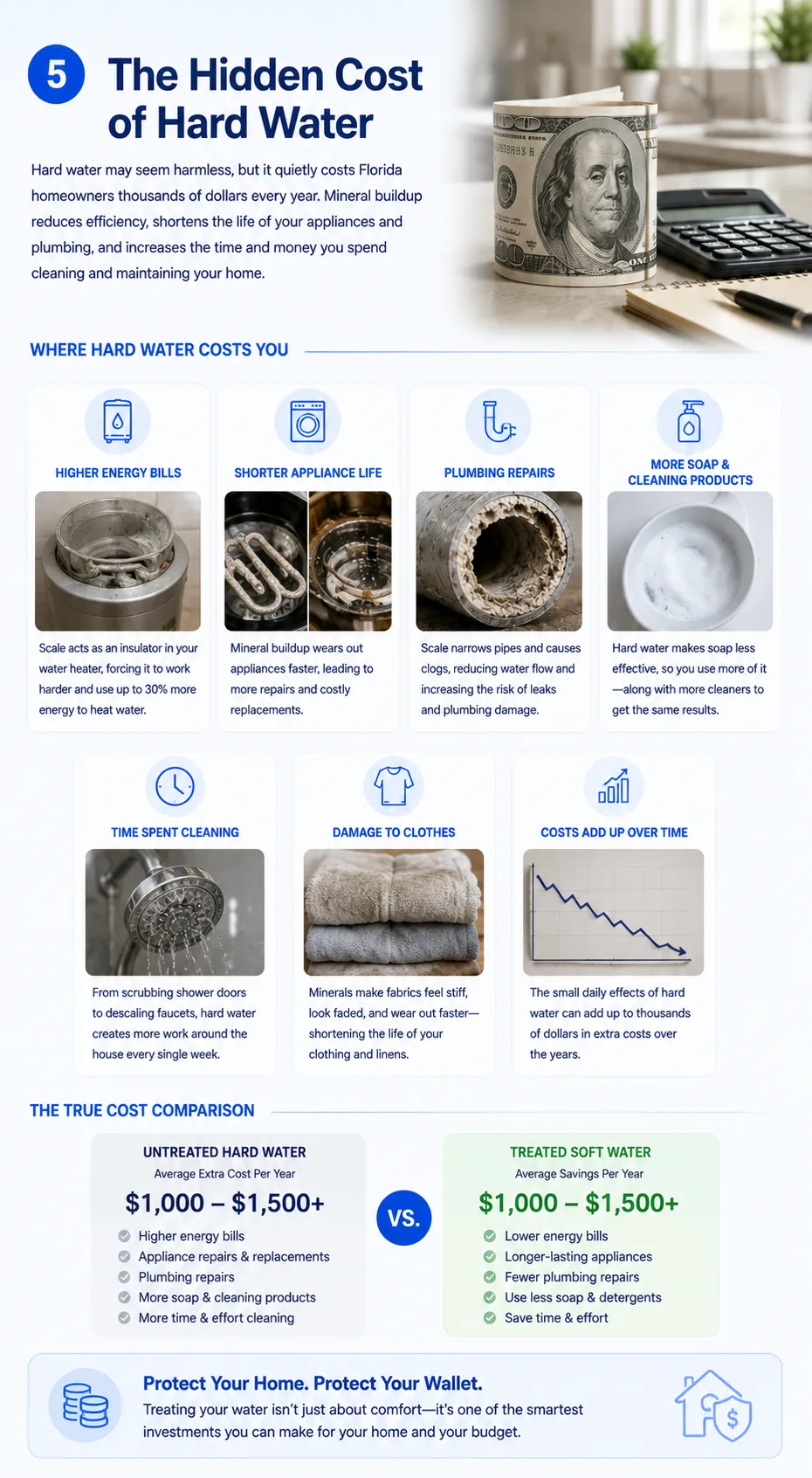
How Hard Water Costs You Money
Many homeowners think hard water is simply an inconvenience, but over time it can become surprisingly expensive. While the effects often develop slowly, the added costs can accumulate year after year.
Mineral scale forces water heaters to work harder, increasing energy consumption and utility bills. Plumbing fixtures, faucet cartridges, shut-off valves, showerheads, and household appliances are all exposed to constant mineral buildup, which can lead to more frequent maintenance, repairs, and replacement.
Hard water also reduces the effectiveness of soaps and detergents. Because calcium and magnesium react with soap before it can do its job, many homeowners find themselves using more shampoo, body wash, laundry detergent, dish soap, and household cleaners just to achieve the same results.
Cleaning your home can also become more time-consuming. Water spots on glass, soap scum in showers, mineral deposits around faucets, and scale buildup on fixtures often require additional cleaning products and more frequent scrubbing to keep bathrooms and kitchens looking their best.
While each of these expenses may seem small on its own, they can add up significantly over the life of a home. From higher utility bills and increased cleaning supplies to shortened appliance life and plumbing repairs, hard water often costs homeowners far more than they realize.
Is Hard Water Safe?
Generally yes.
Hard water is not considered harmful to drink and the minerals themselves are naturally occurring.
However, "safe" doesn't necessarily mean it's ideal for your home.
Hard water can still:
Damage plumbing
Reduce appliance life
Leave mineral deposits everywhere
Make bathing less enjoyable
Increase cleaning time
Will a Water Softener Improve Skin and Hair?
For many homeowners, one of the first benefits they notice after installing a water softener isn't in their plumbing—it's in the shower. While everyone's experience is different, it's very common to hear customers say their skin feels softer, their hair is easier to manage, and they no longer feel like they have a film left behind after bathing.
Hard water contains calcium and magnesium that react with soaps and shampoos before they can do their job. Instead of producing a rich lather that rinses away cleanly, these minerals create a residue often referred to as soap scum. That same residue can remain on your skin and hair, leaving many people with a dry, tight feeling after showering or hair that feels dull, coarse, or difficult to style.
Soft water removes those hardness minerals before they enter your home's plumbing system. Without calcium and magnesium interfering, soaps and shampoos lather more easily, rinse away more completely, and often leave your skin feeling cleaner and your hair softer. Many homeowners also find they need less shampoo, body wash, hand soap, laundry detergent, and conditioner to achieve the same—or even better—results.
Soft water can also make shaving more comfortable. A smoother lather allows razors to glide more easily across the skin, helping reduce irritation for many people.
It's important to remember that a water softener is not a medical treatment and isn't intended to cure skin conditions such as eczema or psoriasis. However, many homeowners with dry or sensitive skin report that bathing in soft water is noticeably more comfortable because it eliminates the mineral residue that hard water can leave behind.
If you've been living with hard water for years, the improvement can be surprisingly noticeable. While protecting your plumbing and appliances is one of the biggest long-term benefits of a water softener, enjoying softer skin, healthier-feeling hair, and a more comfortable shower is often the benefit homeowners appreciate every single day.
What About Drinking Water?
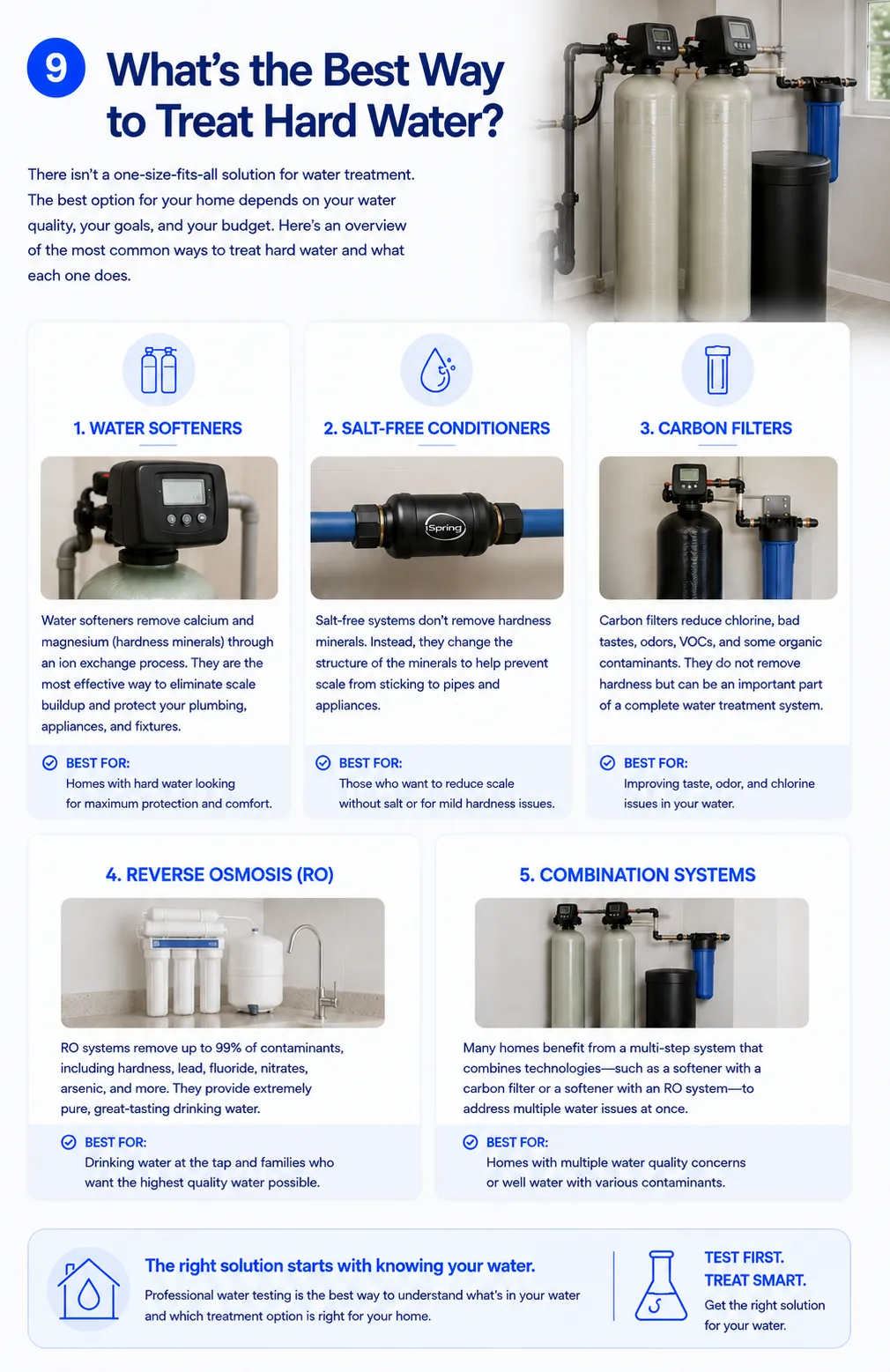
One of the most common misconceptions is that a water softener is designed to make your water "safe" to drink. In reality, a water softener has a very specific job: removing the calcium and magnesium minerals that cause hard water. While this dramatically improves the quality of the water throughout your home, it is not intended to remove chlorine, sediment, dissolved contaminants, or other impurities that may affect the taste or quality of your drinking water.
If your primary goal is cleaner, better-tasting drinking water, a reverse osmosis (RO) system is often the best solution. Reverse osmosis systems are installed at a single faucet, typically in the kitchen, and are designed to reduce a wide range of dissolved contaminants while providing high-quality drinking and cooking water.
Many homeowners choose to pair a water softener with a reverse osmosis system because the two work together exceptionally well. The water softener protects your home's plumbing, fixtures, and appliances from the damaging effects of hard water, while the reverse osmosis system provides purified drinking water exactly where you need it most.
If you're on city water, many homeowners also choose to install a whole-house catalytic carbon filter ahead of the water softener. This helps reduce chlorine and chlorine-related tastes and odors before the water reaches the rest of the home, creating a complete water treatment solution.
The best combination of equipment depends on your water source, your water quality, and your family's goals. That's why a professional water analysis is the first step in determining the right solution for your home.
How Do We Test Your Water?
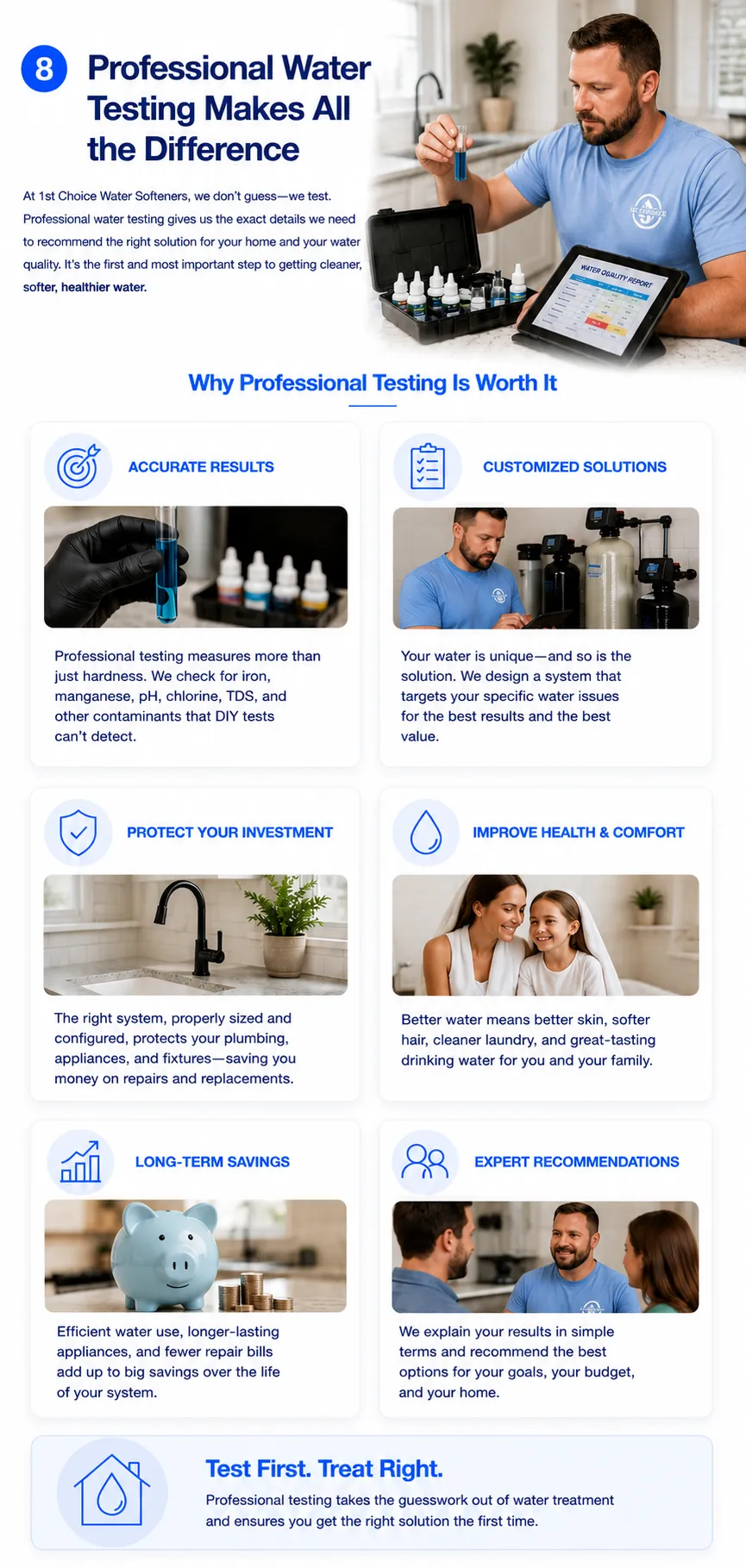
At 1st Choice Water Softeners, every estimate begins with a completely free in-home water analysis. Rather than making recommendations based on your zip code or a general assumption about your area, we test the water coming directly from your home. This allows us to understand exactly what's in your water and recommend a solution tailored to your specific needs.
During your appointment, we'll test for water hardness and, when applicable, check for common Florida water issues such as iron, sulfur, tannins, chlorine, pH, and other factors that may affect water quality. We don't just hand you the results—we explain what each test means, answer your questions, and discuss how your water may be affecting your home.
We'll also take the time to learn about your goals, inspect where your water enters the home, discuss installation options, and identify any plumbing requirements needed for your system. Every recommendation is based on your water, your home, and your family's needs—not a one-size-fits-all sales approach.
Our goal is simple: to provide honest recommendations, educate you about your water, and help you make an informed decision with absolutely no pressure or obligation.
Why Homeowners Choose 1st Choice Water Softeners
Why Homeowners Choose 1st Choice Water Softeners
Choosing a water treatment company isn't just about buying equipment—it's about choosing the people who stand behind it. At 1st Choice Water Softeners, our philosophy has always been simple: Premium Quality. Honest Pricing. Maximum Value.
As the owner and operator, I personally perform every water test, design every system, complete every installation, and provide future service. When you call 1st Choice Water Softeners, you're working directly with the person who will be responsible for your water from start to finish. There are no commissioned salespeople, no subcontractors, and no passing you from one department to another.
Premium quality starts with the equipment we install. That's why we use industry-leading components, premium control valves, high-quality mineral tanks, and carefully selected filtration media designed for long service life and dependable performance. Every component is chosen with reliability and long-term value in mind because we believe the best system is one that continues performing year after year.
Just as important as the equipment is the installation itself. A premium system deserves a premium installation. I take pride in building clean, organized plumbing layouts that are easy to service, built to last, and look like they belong in your home. Whenever possible, I go the extra mile to improve the appearance, accessibility, and overall quality of every installation—even when it means spending several extra hours on the job. Those details may not always be noticed on day one, but they make a difference in reliability, serviceability, and the pride you'll have every time you walk past your equipment.
I also believe homeowners deserve honest recommendations—not the most expensive recommendation. Every system is designed around your water quality, your home's plumbing, your family's water usage, and your goals. If you don't need a larger or more advanced system, I'll tell you. My job is to recommend the solution that provides the greatest long-term value, not simply the highest price.
My goal has never been to be the biggest water treatment company in Florida. My goal is to build systems I'm proud to put my name on, treat every customer's home with the same care I'd expect in my own, and provide a level of craftsmanship and service that's difficult to find today.
That's what Premium Quality. Honest Pricing. Maximum Value. means to me, and it's the standard I strive to deliver on every single installation.
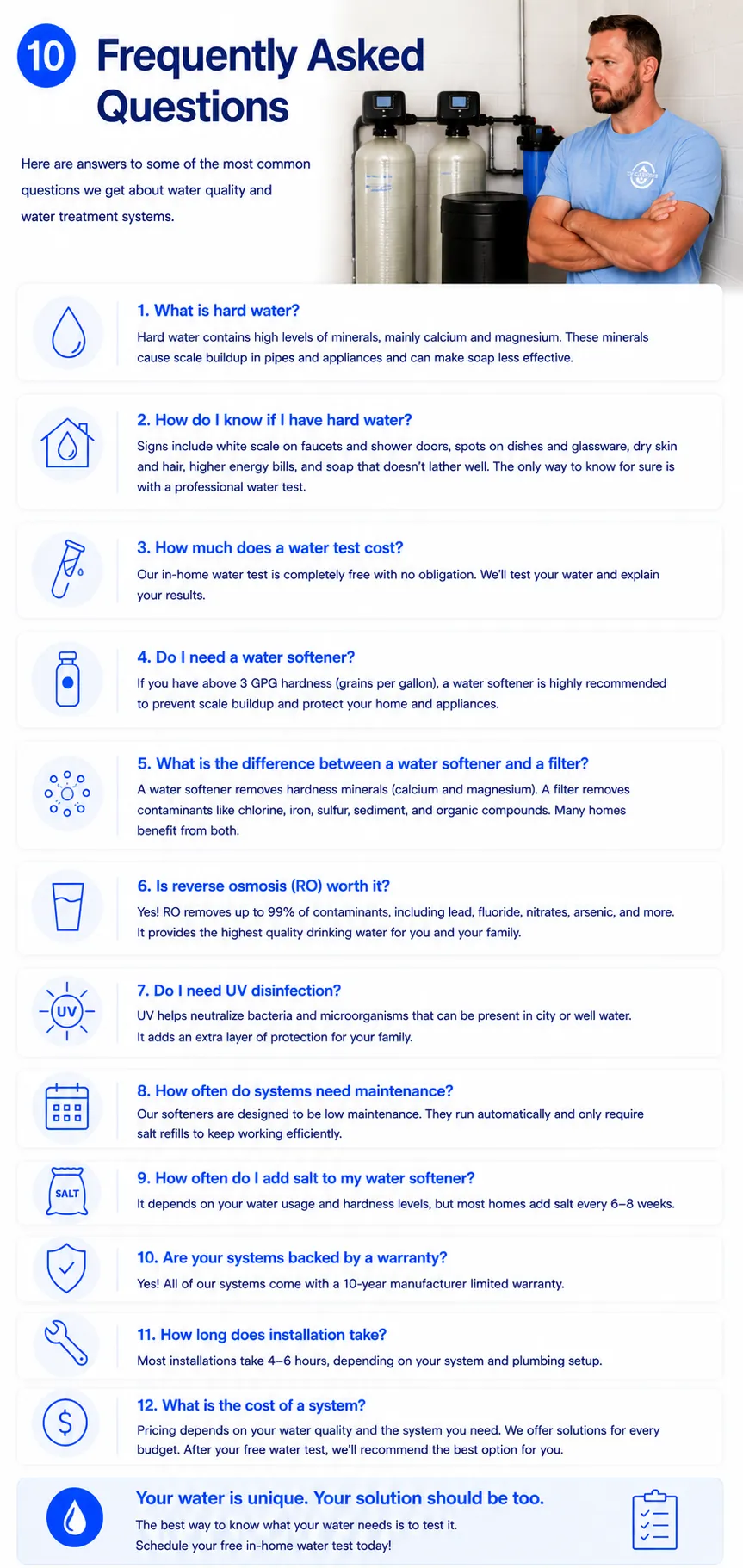
Frequently Asked Questions
Can hard water ruin a water heater?
Yes. Mineral scale builds on heating elements and inside tanks, reducing efficiency and shortening lifespan.
Will hard water clog pipes?
Over many years it can reduce pipe diameter through mineral buildup.
Does boiling water remove hardness?
No. Boiling often leaves even more mineral deposits behind.
Can hard water stain toilets and sinks?
Yes. Hard water commonly leaves white mineral deposits and can contribute to staining. If your stains are orange, brown, or black, iron or manganese may also be present.
How do I know if I need a water softener?
The only reliable way is to test your water.
Schedule Your Free Water Test
If you're experiencing hard water anywhere in Central Florida, I'd be happy to come out and test your water completely free.
We'll discuss:
Your water quality
Your goals
Where the equipment will be installed
Any plumbing requirements
The best options for your home and budget
You'll receive honest recommendations with no pressure.
"An informed homeowner is the best customer. My goal isn't just to sell water treatment systems—it's to help you understand your water so you can make the best decision for your home."
– Tayler
Owner & Operator, 1st Choice Water Softeners
Ready to FIX your Water for GOOD?
Hard Water in Florida: The Complete Homeowners Guide (2026)
If you've noticed white spots on your dishes, stubborn soap scum, dry skin after showering, or appliances wearing out sooner than they should, there's a good chance your home has hard water.
Hard water is one of the most common water quality issues throughout Central Florida. While it isn't considered dangerous to drink, it can quietly cost homeowners hundreds—or even thousands—of dollars over time through damaged plumbing, higher energy bills, excessive soap use, and premature appliance failure.
At 1st Choice Water Softeners, we perform free in-home water testing throughout Central Florida. One of the most common things we hear is:
"I had no idea my water was this hard."
This guide explains everything you need to know.
What Is Hard Water?
Hard water is water that contains elevated levels of naturally dissolved minerals, primarily calcium and magnesium. These minerals are not pollutants or chemicals added by water treatment plants. Instead, they are picked up naturally as water travels through the earth before reaching your home.
To understand hard water, it helps to understand where your water comes from.
Every drop of rain that falls begins as relatively pure water. As that rainwater seeps into the ground, it slowly filters through layers of soil, sand, clay, and rock on its journey toward underground aquifers. During this process, water acts as what scientists often call the "universal solvent." Water molecules naturally dissolve small amounts of minerals from the rocks and soil they pass through.
The amount and type of minerals the water dissolves depends entirely on the geology beneath the surface.
In Florida, this process is especially significant because much of the state sits on the Floridan Aquifer, one of the largest and most productive aquifer systems in the world. The Floridan Aquifer is made up primarily of porous limestone and dolomite, both of which are rich in calcium and magnesium minerals.
As groundwater slowly moves through these limestone formations—sometimes over months, years, or even decades—it continually dissolves tiny amounts of these minerals. By the time the water reaches a residential well or municipal well field, it often contains enough dissolved calcium and magnesium to be classified as hard water.
This is why hard water is so common throughout Florida. It isn't caused by poor water quality or pollution. In fact, it is simply the result of water spending a long time in contact with mineral-rich rock underground.
The hardness of water can vary dramatically from one location to another, even within the same county. Two homes only a few miles apart may have very different hardness levels because they draw water from different depths, different wells, or different portions of the aquifer. One home may have moderately hard water, while another may have extremely hard water despite being on the same street.
Municipal water systems are not immune to hard water either. Most city water in Central Florida also originates from groundwater wells drilled into the Floridan Aquifer. While municipalities disinfect and treat the water to meet drinking water standards, they generally do not remove hardness minerals. Removing calcium and magnesium from millions of gallons of water every day would require large-scale softening facilities that are expensive to build and operate. As a result, many homeowners on city water experience the same hard water problems as homeowners on private wells.
It's also important to understand that calcium and magnesium remain completely dissolved in the water. You cannot usually see them floating in a glass, and hard water often looks just as clear as soft water. In many cases, the only way to know how hard your water is is through proper testing.
Another common misconception is that hard water is caused by sediment or dirt in the water. This is not the case. Sediment consists of solid particles that can often be filtered out with a sediment filter. Hardness minerals, however, are dissolved at the molecular level. Because they are dissolved into the water itself, they pass straight through ordinary sediment filters and most cartridge filters without being removed.
The concentration of calcium and magnesium is what determines how "hard" the water is. Water that has only a small amount of dissolved minerals is considered soft. As those mineral concentrations increase, the water becomes moderately hard, hard, or very hard.
The geology beneath your home has been creating hard water for thousands of years, and it will continue to do so naturally. That's why hard water isn't a temporary problem or something that changes with the seasons. It is simply a characteristic of the groundwater source itself.
Understanding where hard water comes from helps explain why it is so widespread throughout Florida and why treating it requires specialized equipment. Since the minerals are dissolved into the water rather than suspended in it, they cannot simply be strained out with a basic filter. Addressing hard water requires a treatment method specifically designed to remove dissolved hardness minerals before they circulate throughout your home's plumbing system.
How Hard Is Florida Water?
Many areas of Central Florida range between:
8 grains per gallon
15 grains per gallon
20+ grains per gallon
Some wells can exceed 30 grains per gallon.
For comparison:
0–1 GPG = Soft
1–3.5 GPG = Slightly Hard
3.5–7 GPG = Moderately Hard
7–10.5 GPG = Hard
Over 10.5 GPG = Very Hard
Many Florida homeowners are living with water that is considered very hard.
Signs You Have Hard Water
Hard water doesn't usually announce itself with one obvious problem. Instead, it creates a collection of small frustrations that gradually become part of everyday life. Because the minerals are dissolved in the water, it often looks perfectly clear, making it difficult to recognize hard water without proper testing.
Some of the most common signs include:
White spots on dishes and glassware
Soap that doesn't lather well
Soap scum on showers, tubs, and sinks
Dry, itchy skin after bathing
Hair that feels rough, dull, or difficult to manage
White mineral buildup around faucets and showerheads
Reduced water flow from clogged faucet aerators and showerheads
Water heaters that become less efficient over time
Clothes that feel stiff, faded, or less soft after washing
Frequent plumbing fixture or appliance maintenance
Many homeowners assume these issues are simply part of living in Florida, but they're often symptoms of hard water. If you've found yourself constantly cleaning white residue from fixtures, using more soap than you think you should, or replacing faucet cartridges and showerheads more often than expected, hard water could be the underlying cause.
While these signs can strongly suggest hard water, the only way to know for certain is through a professional water analysis. Measuring your water's hardness allows you to determine not only if hard water is present, but also how severe the problem is and whether any additional water quality issues should be addressed.
Does Hard Water Damage Plumbing?
Yes!
Hard water doesn't usually damage your plumbing overnight. Instead, it works slowly over many years as dissolved calcium and magnesium are left behind every time water is heated, evaporates, or changes pressure.
As water travels through your plumbing system, those dissolved minerals remain invisible. However, once water is heated inside a water heater or evaporates from a faucet, showerhead, or fixture, the minerals are no longer able to stay dissolved. They begin to crystallize and attach themselves to nearby surfaces, forming what is known as limescale or mineral scale.
At first, these deposits may seem insignificant, but they continue growing every time water flows through your home. Over the years, a thin layer of scale can become a thick, rock-like coating that affects nearly every plumbing fixture and water-using appliance.
One of the first places homeowners notice hard water is on faucet aerators. The tiny openings inside the aerator gradually become plugged with mineral deposits, restricting water flow and causing uneven spray patterns. Showerheads experience the same problem as individual spray nozzles slowly clog with calcium buildup, reducing pressure and creating an inconsistent spray.
Inside your plumbing system, scale can accumulate on shut-off valves, angle stops, faucet cartridges, toilet fill valves, washing machine valves, and other moving components. Mineral deposits build up on sealing surfaces and moving parts, preventing them from operating as smoothly as they were designed to. As valves become harder to turn and cartridges become more difficult to move, the rubber seals and O-rings are forced to slide across rough mineral deposits instead of smooth machined surfaces. Over time, this additional abrasion can accelerate wear on seals, O-rings, valve seats, and faucet cartridges, increasing the likelihood of drips and leaks.
Hard water can also cause scale to build up where rubber seals meet brass components. Instead of sealing against a smooth surface, the rubber must seal against hardened mineral deposits. This can prevent a complete seal and contribute to leaks over time. In severe cases, repeated scale buildup and removal can leave sealing surfaces rougher than when they were new, making repairs more difficult.
Water heaters are particularly vulnerable because heating water dramatically reduces the ability of calcium to remain dissolved. As a result, hardness minerals settle out of the water and collect on the bottom of tank-style water heaters or coat the heat exchangers inside tankless units. Even a relatively thin layer of scale acts as an insulator, forcing the heating element or burner to work harder to transfer heat into the water. This reduces efficiency, increases energy consumption, and can shorten the life of the appliance.
Hard water also affects your home's cleaning performance. Soap molecules naturally react with calcium and magnesium, creating an insoluble residue commonly known as soap scum. Instead of producing a rich lather, part of the soap is essentially used up reacting with hardness minerals before it ever has a chance to clean. This is why many homeowners find themselves using more shampoo, body wash, laundry detergent, dishwasher detergent, and household cleaners when living with hard water.
Over time, mineral deposits may also collect inside coffee makers, ice makers, humidifiers, dishwashers, washing machines, and other appliances that regularly heat or evaporate water. These deposits can reduce performance, increase maintenance requirements, and shorten the service life of expensive equipment.
Because hard water works gradually, many homeowners don't notice the damage until years have passed. Reduced water flow, stubborn faucet leaks, inefficient water heaters, shortened appliance life, and increased maintenance costs are often the cumulative result of mineral scale slowly building throughout the home's plumbing system.
This gradual process is why hard water is often described as a long-term plumbing issue rather than an immediate one. The water may appear perfectly clear every time it comes out of the tap, but with each gallon used, tiny amounts of dissolved minerals are left behind. Over the course of thousands of gallons, those tiny deposits become a significant source of wear, maintenance, and expense throughout the home.
How Hard Water Costs You Money
Many homeowners think hard water is simply an inconvenience, but over time it can become surprisingly expensive. While the effects often develop slowly, the added costs can accumulate year after year.
Mineral scale forces water heaters to work harder, increasing energy consumption and utility bills. Plumbing fixtures, faucet cartridges, shut-off valves, showerheads, and household appliances are all exposed to constant mineral buildup, which can lead to more frequent maintenance, repairs, and replacement.
Hard water also reduces the effectiveness of soaps and detergents. Because calcium and magnesium react with soap before it can do its job, many homeowners find themselves using more shampoo, body wash, laundry detergent, dish soap, and household cleaners just to achieve the same results.
Cleaning your home can also become more time-consuming. Water spots on glass, soap scum in showers, mineral deposits around faucets, and scale buildup on fixtures often require additional cleaning products and more frequent scrubbing to keep bathrooms and kitchens looking their best.
While each of these expenses may seem small on its own, they can add up significantly over the life of a home. From higher utility bills and increased cleaning supplies to shortened appliance life and plumbing repairs, hard water often costs homeowners far more than they realize.
Is Hard Water Safe?
Generally yes.
Hard water is not considered harmful to drink and the minerals themselves are naturally occurring.
However, "safe" doesn't necessarily mean it's ideal for your home.
Hard water can still:
Damage plumbing
Reduce appliance life
Leave mineral deposits everywhere
Make bathing less enjoyable
Increase cleaning time
Will a Water Softener Improve Skin and Hair?
For many homeowners, one of the first benefits they notice after installing a water softener isn't in their plumbing—it's in the shower. While everyone's experience is different, it's very common to hear customers say their skin feels softer, their hair is easier to manage, and they no longer feel like they have a film left behind after bathing.
Hard water contains calcium and magnesium that react with soaps and shampoos before they can do their job. Instead of producing a rich lather that rinses away cleanly, these minerals create a residue often referred to as soap scum. That same residue can remain on your skin and hair, leaving many people with a dry, tight feeling after showering or hair that feels dull, coarse, or difficult to style.
Soft water removes those hardness minerals before they enter your home's plumbing system. Without calcium and magnesium interfering, soaps and shampoos lather more easily, rinse away more completely, and often leave your skin feeling cleaner and your hair softer. Many homeowners also find they need less shampoo, body wash, hand soap, laundry detergent, and conditioner to achieve the same—or even better—results.
Soft water can also make shaving more comfortable. A smoother lather allows razors to glide more easily across the skin, helping reduce irritation for many people.
It's important to remember that a water softener is not a medical treatment and isn't intended to cure skin conditions such as eczema or psoriasis. However, many homeowners with dry or sensitive skin report that bathing in soft water is noticeably more comfortable because it eliminates the mineral residue that hard water can leave behind.
If you've been living with hard water for years, the improvement can be surprisingly noticeable. While protecting your plumbing and appliances is one of the biggest long-term benefits of a water softener, enjoying softer skin, healthier-feeling hair, and a more comfortable shower is often the benefit homeowners appreciate every single day.
What About Drinking Water?
One of the most common misconceptions is that a water softener is designed to make your water "safe" to drink. In reality, a water softener has a very specific job: removing the calcium and magnesium minerals that cause hard water. While this dramatically improves the quality of the water throughout your home, it is not intended to remove chlorine, sediment, dissolved contaminants, or other impurities that may affect the taste or quality of your drinking water.
If your primary goal is cleaner, better-tasting drinking water, a reverse osmosis (RO) system is often the best solution. Reverse osmosis systems are installed at a single faucet, typically in the kitchen, and are designed to reduce a wide range of dissolved contaminants while providing high-quality drinking and cooking water.
Many homeowners choose to pair a water softener with a reverse osmosis system because the two work together exceptionally well. The water softener protects your home's plumbing, fixtures, and appliances from the damaging effects of hard water, while the reverse osmosis system provides purified drinking water exactly where you need it most.
If you're on city water, many homeowners also choose to install a whole-house catalytic carbon filter ahead of the water softener. This helps reduce chlorine and chlorine-related tastes and odors before the water reaches the rest of the home, creating a complete water treatment solution.
The best combination of equipment depends on your water source, your water quality, and your family's goals. That's why a professional water analysis is the first step in determining the right solution for your home.
How Do We Test Your Water?
At 1st Choice Water Softeners, every estimate begins with a completely free in-home water analysis. Rather than making recommendations based on your zip code or a general assumption about your area, we test the water coming directly from your home. This allows us to understand exactly what's in your water and recommend a solution tailored to your specific needs.
During your appointment, we'll test for water hardness and, when applicable, check for common Florida water issues such as iron, sulfur, tannins, chlorine, pH, and other factors that may affect water quality. We don't just hand you the results—we explain what each test means, answer your questions, and discuss how your water may be affecting your home.
We'll also take the time to learn about your goals, inspect where your water enters the home, discuss installation options, and identify any plumbing requirements needed for your system. Every recommendation is based on your water, your home, and your family's needs—not a one-size-fits-all sales approach.
Our goal is simple: to provide honest recommendations, educate you about your water, and help you make an informed decision with absolutely no pressure or obligation.
Why Homeowners Choose 1st Choice Water Softeners
Why Homeowners Choose 1st Choice Water Softeners
Choosing a water treatment company isn't just about buying equipment—it's about choosing the people who stand behind it. At 1st Choice Water Softeners, our philosophy has always been simple: Premium Quality. Honest Pricing. Maximum Value.
As the owner and operator, I personally perform every water test, design every system, complete every installation, and provide future service. When you call 1st Choice Water Softeners, you're working directly with the person who will be responsible for your water from start to finish. There are no commissioned salespeople, no subcontractors, and no passing you from one department to another.
Premium quality starts with the equipment we install. That's why we use industry-leading components, premium control valves, high-quality mineral tanks, and carefully selected filtration media designed for long service life and dependable performance. Every component is chosen with reliability and long-term value in mind because we believe the best system is one that continues performing year after year.
Just as important as the equipment is the installation itself. A premium system deserves a premium installation. I take pride in building clean, organized plumbing layouts that are easy to service, built to last, and look like they belong in your home. Whenever possible, I go the extra mile to improve the appearance, accessibility, and overall quality of every installation—even when it means spending several extra hours on the job. Those details may not always be noticed on day one, but they make a difference in reliability, serviceability, and the pride you'll have every time you walk past your equipment.
I also believe homeowners deserve honest recommendations—not the most expensive recommendation. Every system is designed around your water quality, your home's plumbing, your family's water usage, and your goals. If you don't need a larger or more advanced system, I'll tell you. My job is to recommend the solution that provides the greatest long-term value, not simply the highest price.
My goal has never been to be the biggest water treatment company in Florida. My goal is to build systems I'm proud to put my name on, treat every customer's home with the same care I'd expect in my own, and provide a level of craftsmanship and service that's difficult to find today.
That's what Premium Quality. Honest Pricing. Maximum Value. means to me, and it's the standard I strive to deliver on every single installation.
Frequently Asked Questions
Can hard water ruin a water heater?
Yes. Mineral scale builds on heating elements and inside tanks, reducing efficiency and shortening lifespan.
Will hard water clog pipes?
Over many years it can reduce pipe diameter through mineral buildup.
Does boiling water remove hardness?
No. Boiling often leaves even more mineral deposits behind.
Can hard water stain toilets and sinks?
Yes. Hard water commonly leaves white mineral deposits and can contribute to staining. If your stains are orange, brown, or black, iron or manganese may also be present.
How do I know if I need a water softener?
The only reliable way is to test your water.
Schedule Your Free Water Test
If you're experiencing hard water anywhere in Central Florida, I'd be happy to come out and test your water completely free.
We'll discuss:
Your water quality
Your goals
Where the equipment will be installed
Any plumbing requirements
The best options for your home and budget
You'll receive honest recommendations with no pressure.
"An informed homeowner is the best customer. My goal isn't just to sell water treatment systems—it's to help you understand your water so you can make the best decision for your home."
– Tayler
Owner & Operator, 1st Choice Water Softeners